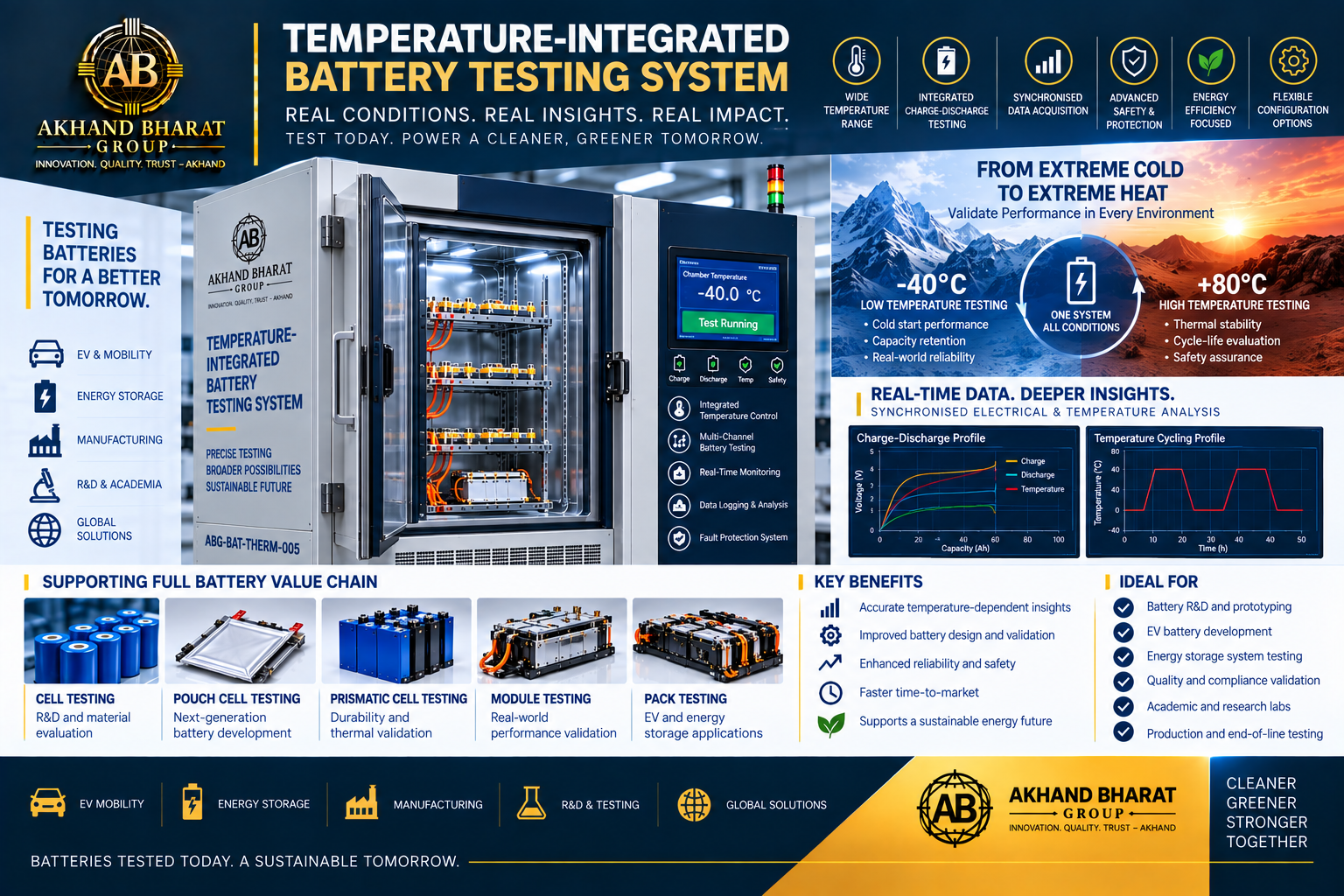
Temperature-Integrated Battery Testing System
SKU: ABG-BAT-THERM-005
Integrated battery electrical and temperature testing solution for controlled charge-discharge, thermal performance, cycle-life, durability and validation across battery cell, module and pack applications.
Overview
The Temperature-Integrated Battery Testing System combines battery electrical testing with controlled thermal environments to evaluate battery behaviour under defined temperature conditions. The system enables engineers to study charge-discharge performance, capacity, cycle life, durability and temperature-dependent characteristics using coordinated electrical and thermal test conditions. Depending on the selected architecture, the solution can combine battery test equipment with an environmental chamber or use an integrated all-in-one configuration. The appropriate architecture is selected according to the DUT, required temperature conditions, electrical test requirements, chamber capacity and laboratory workflow.
Key Features & Highlights
Key Features / Highlights
Integrated Electrical & Temperature Testing for coordinated battery performance evaluation under controlled thermal conditions Controlled Temperature Environment for repeatable battery testing at defined thermal conditions Constant-Temperature Testing for controlled performance and stability evaluation Temperature Cycling for evaluating battery behaviour through changing thermal conditions High- & Low-Temperature Testing for temperature-dependent performance and durability studies Programmable Charge-Discharge Profiles aligned with the selected battery test system Cell, Module & Pack Configurations according to the selected system architecture Synchronized Test Data combining electrical measurements with temperature-related conditions where supported Cycle-Life & Durability Testing under controlled thermal environments Thermal Performance Characterization for understanding temperature effects on battery behaviour Laboratory & R&D Integration with compatible battery testers, chambers and test-control software Configurable System Architecture based on DUT dimensions, electrical requirements, thermal range and testing objectives
Key Capabilities
Key Capabilities
Controlled battery charge-discharge testing under defined thermal conditions Temperature-dependent capacity and performance evaluation Constant-temperature battery testing High- and low-temperature performance evaluation Temperature-cycle testing Cycle-life testing under controlled environmental conditions Thermal-performance characterization Battery durability evaluation Programmable electrical and temperature test profiles Coordinated electrical and thermal data acquisition where supported Cell, module and pack testing according to system configuration Integration with compatible battery test-control software Environmental chamber integration Laboratory-scale and larger battery-testing configurations Support for repeatable thermal test conditions and engineering comparison
Applications
Applications
Battery cell R&D Battery module characterization Battery pack validation Temperature-dependent performance testing Cycle-life testing Battery durability studies High-temperature performance evaluation Low-temperature performance evaluation Temperature cycling Thermal characterization EV battery development Energy-storage battery testing Battery materials research Prototype qualification Laboratory validation Comparative battery testing
Industries Served
Industries Served
EV & Mobility Battery Manufacturing Energy Storage Automotive Engineering Battery Materials Research Battery R&D Testing & Certification Universities & Research Institutions Industrial Energy Systems Advanced Battery Technology
Testing / Operating Workflow
Testing / Operating Workflow
Define the DUT — Identify cell, module or pack and its physical dimensions. Define the Test Objective — Establish performance, durability, cycle-life or thermal-characterization requirements. Define Electrical Requirements — Determine the required voltage, current, power and channel configuration. Define Thermal Conditions — Establish constant-temperature, temperature-cycle or high/low-temperature requirements. Select System Architecture — Select an integrated or chamber-linked configuration appropriate to the application. Configure Test Profile — Program the required charge-discharge and thermal sequence. Install the DUT — Position and connect the battery using the appropriate fixture and electrical interfaces. Verify Safety Conditions — Confirm electrical connections, thermal settings and applicable protection systems. Execute Testing — Run the programmed electrical and thermal test sequence. Acquire Test Data — Record electrical parameters together with temperature conditions where supported. Analyse Results — Evaluate capacity, performance, degradation, cycle behaviour and temperature dependence. Generate Reports — Document the test conditions, results and engineering conclusions.
Software & Data Management
Software & Data Management
Battery test procedures can be configured according to the selected test platform. Electrical testing and temperature-control functions can be coordinated where the system architecture supports integrated operation. Temperature conditions can be associated with corresponding battery electrical test data. Charge-discharge and temperature-cycle profiles can be configured for applicable systems. Real-time test monitoring can be available through compatible test-control software. Test curves and recorded parameters can be reviewed for engineering analysis. Test data can support capacity, cycle-life, performance and temperature-response evaluation. Reporting and data-export functions depend on the selected software configuration. Server/client, monitoring and advanced analysis functionality is configuration-dependent. Current official material specifically describes BTS integration of temperature control with battery performance testing and synchronization of charge/discharge data with temperature data.
Safety & Protection
Safety & Protection
Operate the system within the specified electrical and thermal limits of the selected configuration. Verify battery connections, polarity and fixture installation before starting the test. Use appropriate thermal and electrical protection for the DUT and test environment. Follow the applicable chamber operating and laboratory safety procedures. Use appropriate protective arrangements for high-voltage or high-current battery testing. Temperature limits and safety interlocks should be configured according to the selected chamber and test application. Abnormal temperature, electrical or system conditions should be handled through the applicable protection architecture. High-energy battery testing requires qualified installation, appropriate containment and application-specific safety procedures. Final safety functionality depends on the selected system configuration. Official all-in-one systems describe safety functions such as alarms, over-temperature protection and other protective mechanisms, but these should not be presented as universal ABG specifications across every configuration.
System Integration
System Integration
Battery cell testing systems Battery module testing systems Battery pack testing systems Environmental test chambers Integrated temperature-control battery testing systems Battery fixtures and connection accessories Battery testing software Laboratory data-management systems BMS validation environments where applicable Temperature monitoring and sensing systems R&D laboratory infrastructure Production and validation test environments where appropriately configured
Configuration Options
Configuration Options
Cell Testing Configuration Pouch Cell Configuration Cylindrical Cell Configuration Prismatic Cell Configuration Module Testing Configuration Pack Testing Configuration Constant-Temperature Testing High-Temperature Testing Low-Temperature Testing Temperature-Cycling Configuration Integrated All-in-One Configuration External Environmental-Chamber Integration Single-Zone Configuration Multi-Zone Configuration where applicable Programmable Charge-Discharge Profiles Cycle-Life Testing Configuration Thermal Characterization Configuration Application-Specific Fixtures and Connections Software and Data-Management Integration
Benefits & Value Proposition
Benefits / Value Proposition
Combined Electrical & Thermal Evaluation — Study battery performance together with controlled temperature conditions. Repeatable Test Environment — Improve consistency between comparative battery tests. Temperature-Dependent Characterization — Identify changes in battery behaviour across defined thermal conditions. Flexible Test Profiles — Configure electrical and temperature sequences according to the test objective. Cycle-Life & Durability Assessment — Evaluate battery behaviour during extended testing. Cell-to-Pack Flexibility — Support different battery test levels according to system configuration. Integrated Data Evaluation — Correlate electrical test results with thermal conditions where supported. Laboratory Efficiency — Integrated architectures can reduce the complexity of coordinating separate systems. Scalable Configuration — Select chamber, tester and channel architecture according to the application. Engineering Decision Support — Generate structured test data for battery development, validation and qualification.
Frequently Asked Questions
What is a Temperature-Integrated Battery Testing System?
It is a battery-testing architecture that combines electrical charge-discharge testing with controlled temperature conditions to evaluate battery performance, durability and thermal response.
Can it test both charging and discharging?
Yes. The electrical testing component can support programmable charge-discharge testing according to the selected battery tester configuration.
Can temperature cycling be performed?
Yes. Temperature-cycle testing can be configured where supported by the selected thermal system and test architecture.
Can it test battery cells, modules and packs?
Yes, depending on the selected electrical tester, chamber configuration, fixture arrangement and application requirements.
Can the system perform high- and low-temperature testing?
High- and low-temperature configurations are available, with the actual operating range depending on the selected environmental chamber or integrated system.
Can electrical and temperature data be synchronized?
Compatible integrated architectures can coordinate electrical test data with temperature conditions, supporting analysis of temperature-dependent battery performance.
Can it be integrated with an existing battery tester?
es. Environmental-chamber integration can be designed around compatible battery-testing equipment and the required laboratory architecture.
Is it suitable for cycle-life testing?
Yes. Controlled thermal conditions can be combined with repeated charge-discharge profiles for cycle-life and durability studies.
Is it suitable for EV battery testing?
Yes. Appropriately configured systems can support EV battery cell, module and pack development and validation workflows.
Is the temperature range fixed?
No. Temperature range, chamber volume, electrical configuration and other parameters depend on the selected system configuration.
Can the system support energy-storage battery testing?
Yes. Temperature-controlled testing can be used for energy-storage battery performance, durability and thermal-condition evaluation.
Q12. Can ABG configure the system according to our laboratory requirement?
Yes. ABG can structure the appropriate testing architecture based on DUT type, electrical requirements, thermal conditions, test profiles, laboratory constraints and integration requirements.
Technical Specifications
| Test level | Cell / module / pack configuration-dependent |
| Thermal control | Controlled temperature test environment |
| Core functions | Cycling, performance and thermal-condition evaluation |
| Applications | R&D, validation, durability and thermal characterisation |
| Test Functions | Charge, discharge, cycling, capacity and performance evaluation |
| Temperature Testing | Controlled temperature testing and temperature cycling |
| Thermal Environment | Constant-temperature and high/low-temperature configurations |
| Temperature Range | Configuration-dependent |
| Chamber Capacity | Configuration-dependent |
| Battery Test Channels | Configuration-dependent |
| Electrical Voltage / Current | Application and tester configuration-dependent |
| Data Synchronization | Electrical test data with temperature conditions where supported |
| Test Profiles | Programmable charge-discharge and temperature profiles |
| Cycle Testing | Cycle-life and durability testing |
| Thermal Characterization | Temperature-dependent battery performance evaluation |
| Safety Features | Configuration-dependent electrical and thermal protection |
| Software Integration | Compatible battery test-control and data-management software |
| Communication / Interfaces | Configuration-dependent |
| DUT Format | Cell, module or pack depending on system configuration |
| Applications | R&D, validation, durability, thermal characterization and qualification |
Technical buying guidance
Related buyer guides & requirements
Battery Tester Selection Guide
Define voltage, current, channels, temperature and data requirements before finalising a battery test-system configuration.
Read guideBattery Pack Testing Requirements
Review pack-level electrical, validation and test-matrix inputs where the product is used for pack testing.
Read guideBMS Testing Validation Lab
Connect battery testing with BMS simulation, communication, I/O and laboratory validation requirements.
Read guideTell Us About Your Testing Requirement
Share what you already know. You do not need to have every specification finalized before starting a technical discussion.