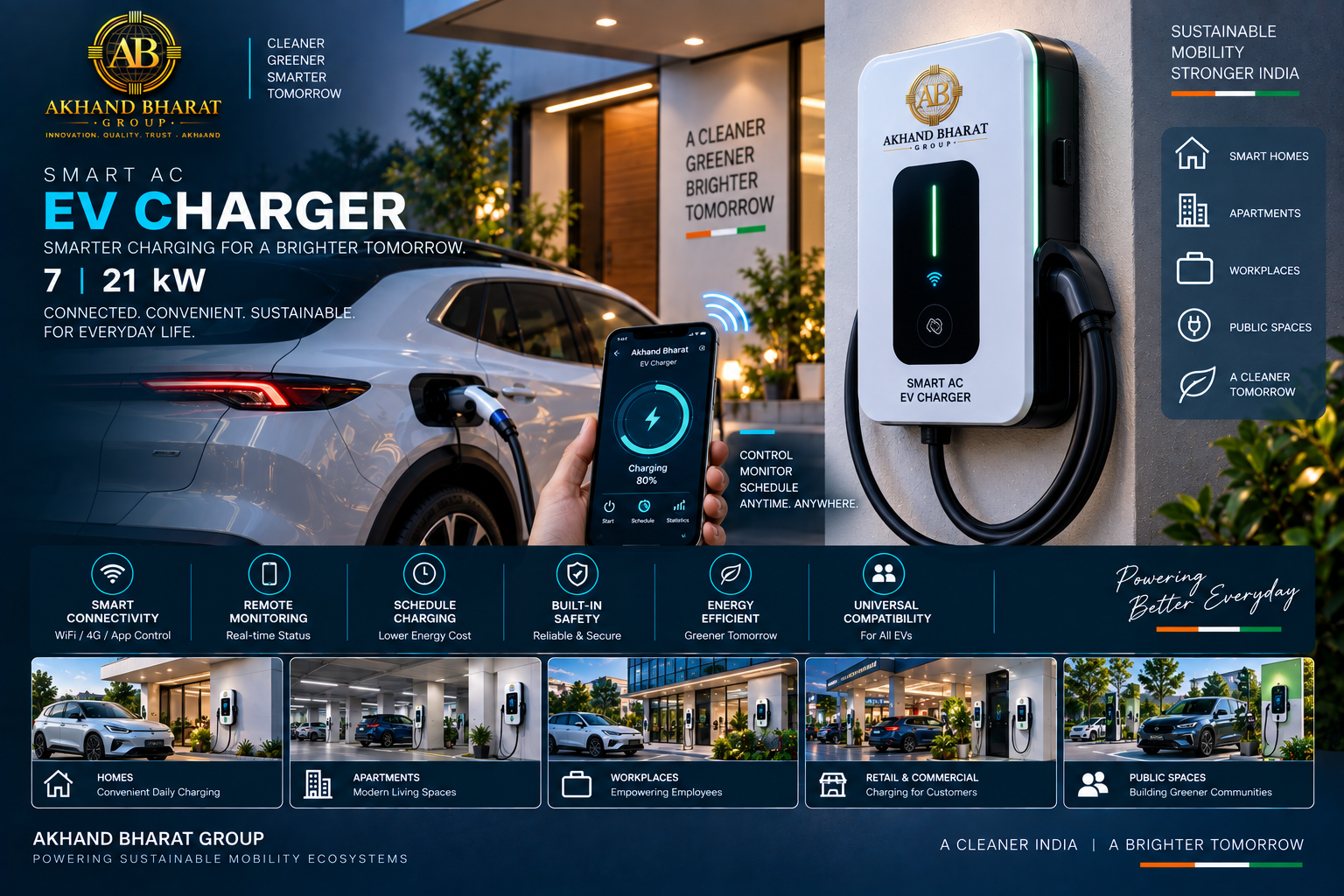
Smart AC EV Charger – 7 kW / 21 kW
SKU: ABG-EVC-AC-SMART-0721
Smart and versatile AC EV charging solution available in 7 kW and 21 kW configurations, designed for residential, workplace, commercial and destination charging with intelligent connectivity, remote management and advanced electrical protection.
Overview
Akhand Bharat Group Smart AC EV Charger is an intelligent and scalable charging solution designed to support the growing requirements of modern electric mobility infrastructure. Available in 7 kW and 21 kW configurations, the charger is suitable for a wide range of applications including residential developments, workplaces, commercial establishments, real estate projects, destination charging locations and organised EV parking facilities. The system combines reliable AC charging with smart connectivity options including Wi-Fi, Bluetooth and optional 4G, enabling convenient charging management and remote control capabilities. Support for OCPP 1.6J cloud integration allows the charger to be incorporated into connected EV charging networks and intelligent charging management platforms. Designed with a comprehensive electrical protection architecture, the solution includes protection against grounding faults, lightning, overvoltage, undervoltage, overcurrent, overheating and leakage current, depending on the configured standard and connector interface. With multiple international interface options, flexible installation possibilities and OEM/ODM customisation capability, the Smart AC EV Charger provides a scalable solution for businesses and infrastructure developers building reliable EV charging ecosystems. Key Applications Residential EV Charging Apartment & Housing Projects Workplace Charging Commercial Buildings Hotels & Hospitality Shopping & Retail Locations Real Estate Projects Destination Charging Corporate Parking Organised EV Charging Networks
Technical Specifications
| Model | SLX-AC7K |
| Rated Output | 7 kW / 21 kW |
| Input Voltage | 230V ± 15% AC / 380V ± 15% AC |
| Input Frequency | 50 / 60 Hz |
| Output Voltage | 230V ± 15% AC / 380V ± 15% AC |
| Output Current | 32A |
| Charging Interface | GB/T / Type 2 / Type 1 / Tesla TPC |
| Number of Charging Interface | Single |
| Cable Length | 5 m Standard |
| Display | Display Screen + Indicator Light |
| Charging Operations | Plug & Play / RFID Card / Bluetooth / Wi-Fi / 4G |
| Connectivity | Wi-Fi / Bluetooth / 4G |
| Communication Protocol | OCPP 1.6 JSON |
| User Management | Bluetooth / Wi-Fi / Smart APP |
| RCD Protection | GB/T: Type A; Type 2: Type A + 6 mA DC; Type 1: CCID20 |
| Grounding Detection | Supported |
| Lighting Protection | Supported |
| Voltage Protection | Overvoltage / Undervoltage Protection |
| Current Protection | Overcurrent Protection |
| Temperature Protection | Over-temperature Protection |
| Leakage Current Protection | Supported |
| Overcharge Protection | Supported |
| Protection Level | IP55 |
| Operating Temperature | -30°C to +50°C |
| Relative Humidity | 5% to 95% Non-Condensing |
| Storage Temperature | -40°C to +80°C |
| Maximum Altitude | Below 2000 m |
| Installation Method | Wall-Mounted / Floor-Standing |
| Product Size | 340 × 225 × 87 mm |
| Shell Material | PC + ABS |
| Available Colours | Black / White / Grey / Customizable |
| Applicable Standards | GB/T 18487.2 |
| Cloud Integration | OCPP 1.6J |
| Application | Residential & Apartment Charging | Corporate Workplaces | Hotels & Resorts | Shopping Centres | EV Dealerships | Commercial Parking | Fleet Charging | Destination Charging |
Technical buying guidance
Related buyer guides & requirements
DC Fast Charger Selection Guide
Match charger power, connector, communications and operating requirements to the intended site.
Read guideEV Charger Site Power Requirements
Validate sanctioned load, transformer capacity and simultaneous charging demand before deployment.
Read guideFleet Charging Infrastructure
Translate vehicle duty cycles, depot schedules and electrical constraints into the charging architecture.
Read guideTell Us About Your Charging / Energy Requirement
Share what you already know. You do not need to have every specification finalized before starting a technical discussion.