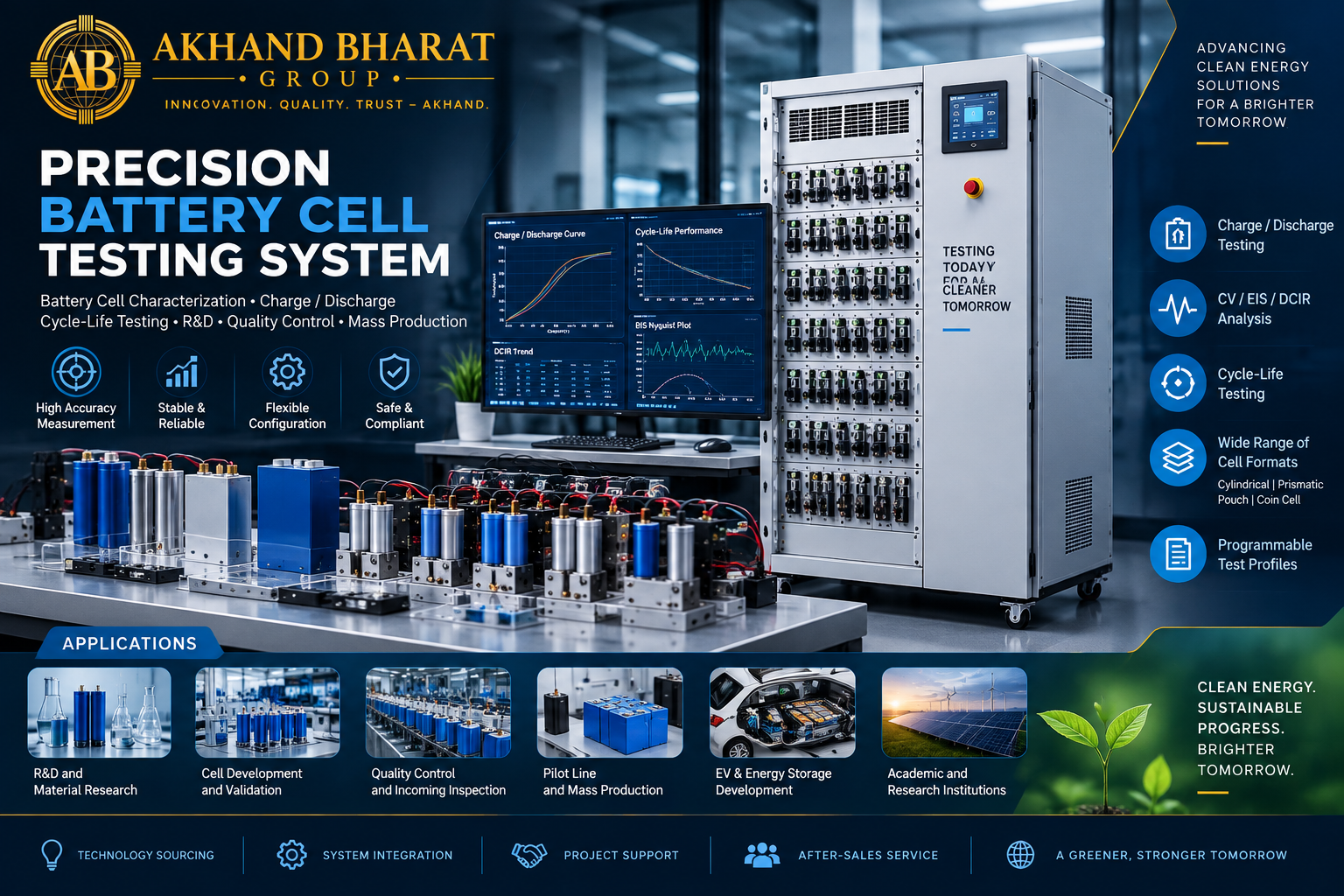
Precision Battery Cell Testing System
SKU: ABG-BTTV-CELL-PTS
A precision-engineered battery cell testing platform designed for accurate charge–discharge characterization, capacity measurement, cycling, performance evaluation and reliability testing of rechargeable battery cells across R&D, quality-control and validation environments.
Overview
A configurable battery cell testing platform for repeatable charge/discharge characterization, cycle-life studies, rate capability, pulse testing, formation/conditioning and prototype validation. ABG can configure the appropriate platform and accessories around the customer's cell format, chemistry and test methodology.
Key Features & Highlights
Cell-to-prototype coverage
Supports battery development from laboratory cell characterization through prototype verification and validation.
Multiple cell formats
Configurations are available for coin, pouch, cylindrical and prismatic cells.
Advanced electrochemical testing
Selected CT/CE-8000 and CT-9000 configurations support advanced characterization including CV, EIS, DCIR and pulse testing.
Programmable testing
Charge/discharge, rest, cycling, pulse and conditional test sequences can be configured to the application.
Key Capabilities
Charge / discharge characterization
CC, CV and programmable charge/discharge profiles for capacity, energy and performance evaluation.
Cycle-life testing
Long-duration cycling for degradation, capacity retention and durability studies.
Rate capability
Controlled current-rate testing for comparative performance characterization.
Pulse and dynamic testing
Applicable configurations support short-duration pulse characterization and dynamic response analysis.
Electrochemical characterization
Selected configurations support CV/EIS and other research workflows.
Applications
Battery R&D
Cell performance and electrochemical development.
Prototype validation
Verification of new cell designs and manufacturing variants.
Quality control
Repeatable electrical characterization and consistency checks.
Aging studies
Cycle-life and degradation evaluation under controlled test protocols.
Industries Served
EV and automotive
Cell development and validation for electric mobility.
Energy storage
Cell characterization for stationary and distributed energy storage.
Battery manufacturers
R&D, process validation and quality laboratories.
Universities and research institutes
Electrochemical and next-generation battery research.
Testing / Operating Workflow
1. Define DUT and test envelope
Confirm chemistry, format, nominal voltage, current, channel count and environmental conditions.
2. Configure test method
Create charge/discharge, rest, pulse, cycling or electrochemical characterization sequences.
3. Execute controlled testing
Acquire electrical and auxiliary data using the selected tester and fixtures.
4. Analyze results
Evaluate capacity, energy, efficiency, degradation and other configured parameters.
5. Validate and report
Compare results against acceptance criteria and export test data/reports.
Software & Data Management
BTS test programming
Programmable test steps, cycles, conditions, data recording and analysis through the applicable NEWARE BTS platform.
Data management
Structured test records, analysis and report export according to the selected system/software configuration.
Safety & Protection
Programmable protection
Voltage, current and other test-limit protections are configured according to the selected system and application.
Application-specific safeguards
Fixture, chamber and auxiliary safety integration can be included where required.
System Integration
Environmental equipment
Selected systems can integrate with temperature chambers and auxiliary equipment for controlled-condition testing.
Cell fixtures
Fixtures and racks can be selected for coin, pouch, cylindrical or prismatic cells.
Configuration Options
Tester family
CT/CE-8000, CT-9000 or other applicable NEWARE platform selected against the test requirement.
Electrical envelope
Voltage, current, power, channel count and sampling requirements are specified per model.
DUT format
Coin, pouch, cylindrical and prismatic cell fixtures available according to the selected configuration.
Benefits & Value Proposition
Repeatable engineering data
Controlled and programmable test methods improve comparability across cells and batches.
Scalable testing
Configuration can grow from laboratory R&D to validation and production-oriented requirements.
Application-specific engineering
ABG can help translate the customer test objective into a suitable system configuration.
Frequently Asked Questions
Can you configure the system for our exact cell format?
Yes. Configuration is selected according to cell format, chemistry, voltage, current, channel count and test method.
Can the system perform cycle-life testing?
Yes. Cycle-life and long-duration charge/discharge testing are core applications.
Can advanced CV/EIS testing be included?
Yes, where the selected CT/CE-8000 configuration supports the required CV/EIS functions.
Technical Specifications
| Test level | Battery cell |
| Core functions | Precision cycling, capacity and lifecycle analysis |
| Applications | Cell R&D, incoming inspection, validation and research |
Technical buying guidance
Related buyer guides & requirements
Battery Tester Selection Guide
Define voltage, current, channels, temperature and data requirements before finalising a battery test-system configuration.
Read guideBattery Pack Testing Requirements
Review pack-level electrical, validation and test-matrix inputs where the product is used for pack testing.
Read guideBMS Testing Validation Lab
Connect battery testing with BMS simulation, communication, I/O and laboratory validation requirements.
Read guideTell Us About Your Testing Requirement
Share what you already know. You do not need to have every specification finalized before starting a technical discussion.