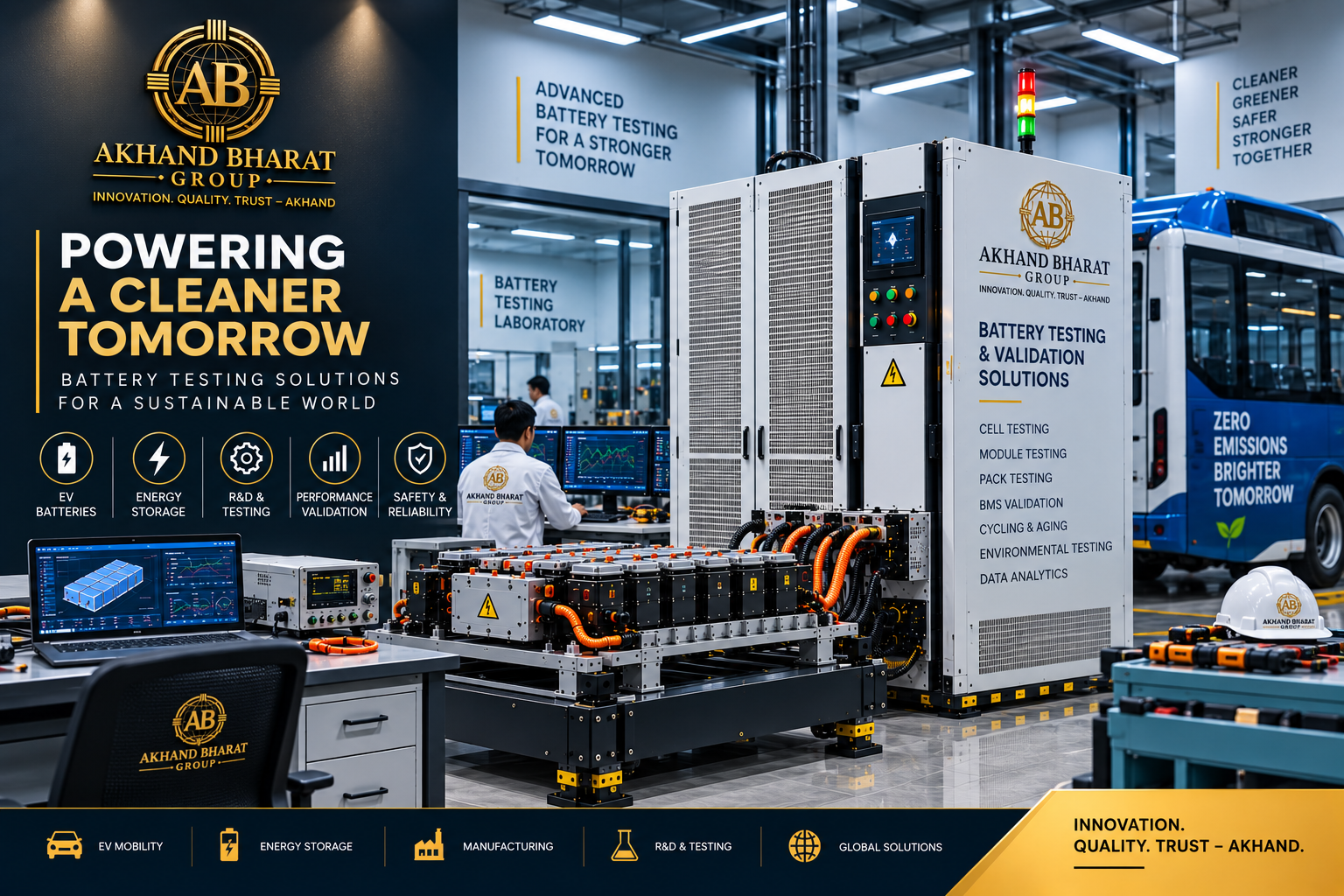
High-Power Battery Testing System
SKU: ABG-BAT-HP-006
High-power battery testing solution for controlled charge–discharge, dynamic load, pulse, cycle-life, DCIR and performance validation across EV, energy-storage and industrial battery applications.
Overview
High-Power Battery Testing System is a configurable battery testing solution designed for high-power charge–discharge, dynamic-load, pulse, cycle-life and performance validation of battery modules, packs and energy-storage systems. The system can be configured according to the required voltage, current, power, channel capacity, test profile, BMS interface and laboratory environment, with support for regenerative operation and integration with temperature-control and other test equipment where required.
Key Features & Highlights
Key Features / Highlights
High-power battery charge–discharge testing Programmable dynamic-load and pulse testing Cycle-life and durability testing DCIR / resistance characterization EV battery module and pack validation Energy-storage battery testing Regenerative energy recovery where supported Configurable voltage, current and power BMS and peripheral-system integration High-resolution measurement and data acquisition Automated test-profile execution Scalable laboratory and production configurations
Key Capabilities
Core Capabilities
Charge–Discharge Testing Programmable CC/CV and controlled charge–discharge sequences for battery performance characterization. Dynamic & Pulse Testing Reproduce changing current or power conditions for realistic operating-condition simulation. Cycle-Life Testing Automated repeated cycling for durability, capacity-retention and degradation studies. DCIR Characterization Support resistance-related performance characterization using appropriate test profiles. High-Power Validation Designed for applications requiring substantial current and power during battery validation. Regenerative Operation Applicable configurations can recover energy generated during discharge rather than dissipating the full energy load as heat.
Applications
Applications
EV battery module testing EV battery pack validation Commercial and fleet EV battery testing Energy-storage battery validation BESS performance testing Cycle-life and durability testing Dynamic-load simulation Pulse testing DCIR characterization Battery performance benchmarking R&D validation Production qualification Laboratory expansion and modernization
Industries Served
Industries Served
Electric Vehicle & Mobility Battery Manufacturing Energy Storage Systems Automotive Engineering Commercial & Fleet Mobility Renewable Energy Battery R&D Laboratories Industrial Electrification Testing & Certification
Testing / Operating Workflow
Testing Workflow
Define DUT voltage/current/power envelope Select appropriate test configuration Connect battery and safety interfaces Configure test profile Verify protection parameters Execute charge/discharge sequence Run dynamic or pulse profiles where required Monitor electrical parameters in real time Perform DCIR/performance measurements Continue automated cycle-life testing where required Record and analyse test data Generate test results and engineering reports
Software & Data Management
Software & Data Management
Programmable test sequences Profile management Real-time test monitoring Current/voltage/power data acquisition Cycle and step management Dynamic profile execution Test-result recording Data analysis Report generation Configuration-dependent LIMS/data-system integration The underlying CE-6000 ecosystem also supports LIMS/BIS-oriented data management, according to the current official product information.
Safety & Protection
Safety & Protection
The solution architecture can incorporate: Over-voltage protection Over-current protection Over-temperature protection Short/open-circuit protection Emergency-stop protection Polarity-reversal protection Self-diagnostic protection Power-failure/resumption protection Adjustable protection thresholds Protection-event logging BMS monitoring/integration These protection functions are documented for the relevant pack-testing architecture.
System Integration
System Integration
The platform can be integrated, subject to configuration, with: BMS CAN / CAN FD systems Ethernet/TCP-IP RS485 devices Temperature chambers Battery cooling/chiller systems Vibration systems External measurement equipment Laboratory automation Production test systems The official pack-testing architecture specifically describes integration with BMS, chambers, chillers and vibration testers.
Configuration Options
Configuration Options
Final configuration is selected according to battery voltage, current, power, number of channels, test profile, DUT format, environmental requirements, BMS interface and required automation level. Possible configurations can include different power classes and voltage/current combinations; the official CE-6000 material documents examples including 100 kW, 150 kW and 300 kW configurations and states that other configurations can be customized.
Benefits & Value Proposition
Benefits / Value Proposition
Reproducible high-power battery testing Realistic dynamic-condition simulation Reduced manual intervention Efficient cycle-life testing Detailed electrical characterization Scalable system architecture Integration with BMS and laboratory peripherals Regenerative energy operation where applicable Better test-data traceability Suitable for R&D through validation and production environments
Frequently Asked Questions
What batteries can be tested?
The system can be configured for battery modules, packs and energy-storage systems according to their electrical and test requirements.
Is the system suitable for EV battery packs?
Yes. High-power pack testing is one of the documented applications of the underlying architecture.
Can dynamic driving profiles be tested?
Yes. Programmable and simulation-based operating profiles are supported on applicable configurations.
Does it support regenerative testing?
Applicable configurations can recover energy generated during battery discharge.
Can it integrate with BMS and environmental equipment?
Yes, subject to configuration, including BMS, temperature chambers, chillers and other laboratory peripherals.
Can the system be customized?
Yes. Voltage, current, power and other system parameters can be selected according to the DUT and test requirement.
Technical Specifications
| Test level | Module / battery pack / energy-storage system |
| Core functions | High-power cycling, performance and durability testing |
| Applications | EV batteries, ESS and high-power R&D |
| Test Mode | Charge, discharge, pulse, dynamic-load and cycle testing |
| Voltage | Configuration-dependent |
| Current | Configuration-dependent |
| Power | Configuration-dependent |
| Measurement | High-resolution electrical measurement |
| Dynamic Testing | Programmable current/power profiles |
| DCIR | Supported according to selected configuration |
| Energy Recovery | Regenerative architecture available on applicable configurations |
| Communication | Configuration-dependent; CAN / CAN FD / Ethernet / RS485 options |
| BMS Integration | Supported according to system configuration |
| Environmental Integration | Temperature chamber, cooling/chiller and other peripherals where required |
| Test Data | Real-time monitoring, recording, analysis and reporting |
| Customization | Voltage/current/power/channel configuration according to DUT |
Technical buying guidance
Related buyer guides & requirements
Battery Tester Selection Guide
Define voltage, current, channels, temperature and data requirements before finalising a battery test-system configuration.
Read guideBattery Pack Testing Requirements
Review pack-level electrical, validation and test-matrix inputs where the product is used for pack testing.
Read guideBMS Testing Validation Lab
Connect battery testing with BMS simulation, communication, I/O and laboratory validation requirements.
Read guideTell Us About Your Testing Requirement
Share what you already know. You do not need to have every specification finalized before starting a technical discussion.