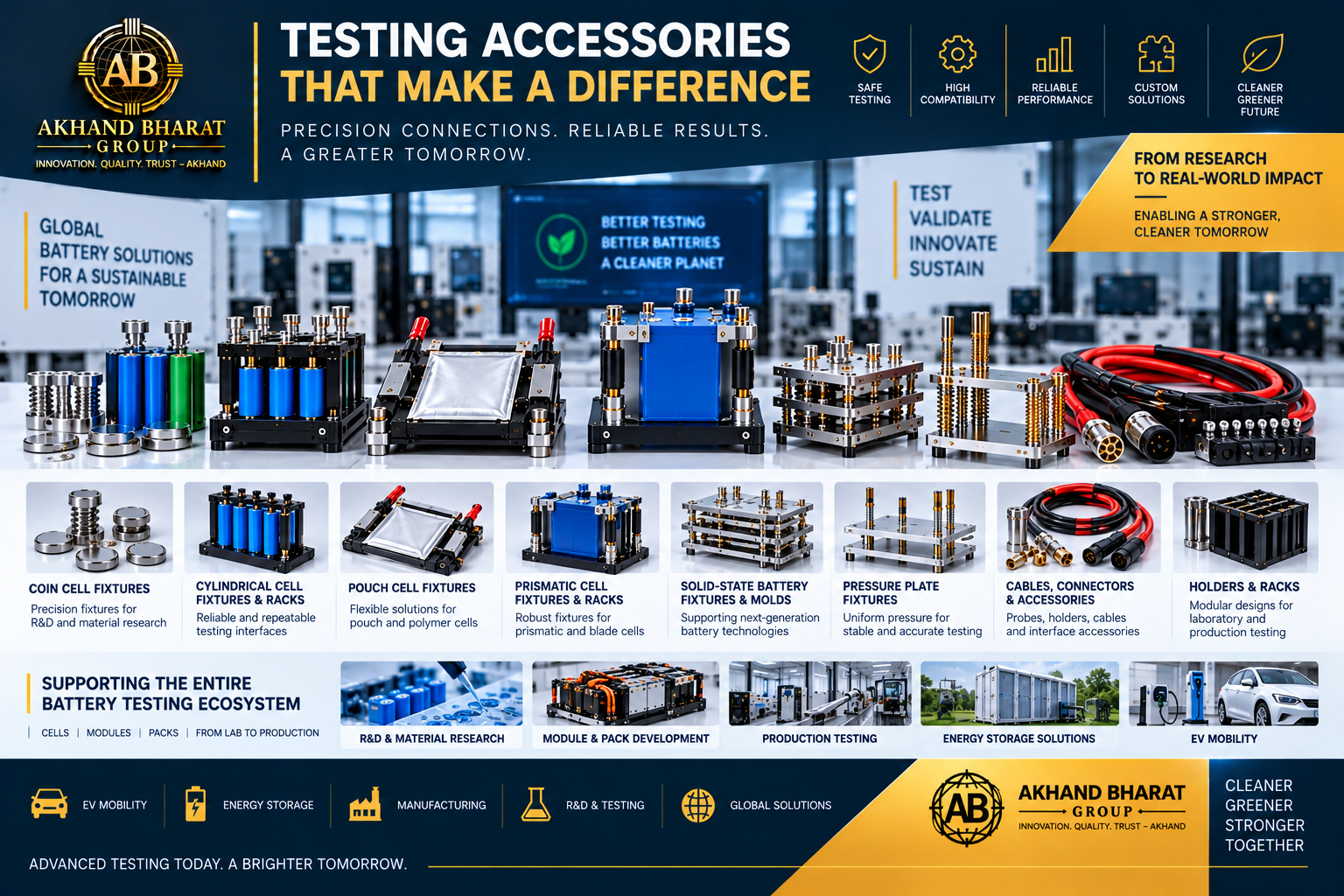
Battery Test Fixtures & Accessories
SKU: ABG-BAT-FIX-007
Comprehensive battery test fixtures and accessories for reliable cell, module and pack connection, mechanical support and laboratory test integration.
Overview
Battery Test Fixtures & Accessories provide the mechanical and electrical interface layer required to connect battery cells, modules and packs to compatible test equipment. The portfolio covers common battery formats and specialist laboratory configurations, with fixture selection based on cell geometry, test current, pressure requirements, channel count, connection method and the selected test system.
Key Features & Highlights
Coin cell fixtures for laboratory cell testing
Pouch / polymer cell fixtures and pressure-oriented configurations
Cylindrical cell clamps, holders and racks
Prismatic cell clamps, holders and racks
Blade battery clamp configurations
Solid-state battery fixtures and mold-style test interfaces
Pressure plate and pressure fixture solutions
Battery holders, racks and multi-channel fixture arrangements
Probes, contacts, connectors, cables and harnesses where required
Application-specific mechanical and electrical interfaces
Calibration and supporting accessories for compatible test workflows
Configuration matched to the selected battery testing platform
Key Capabilities
Secure and repeatable battery-to-tester electrical connection
Mechanical positioning and retention of cells during testing
Controlled contact pressure for applicable cell formats
Multi-channel fixture and rack arrangements
Cell-format-specific test interfaces
Module and pack connection support
Integration with compatible battery cyclers and test systems
Support for laboratory, validation and production test workflows
Replacement and application-specific fixture sourcing
Configuration review based on test method and DUT geometry
Applications
Coin-cell research and electrochemical testing
Pouch-cell characterization and cycling
Cylindrical-cell testing and multi-channel laboratory setups
Prismatic and blade-cell testing
Solid-state battery research
Battery module test connection
Battery pack test connection and service interfaces
Cycle-life and performance testing
R&D laboratory test benches
Validation and quality laboratories
Production and end-of-line test support
Fixture replacement and test-system expansion
Industries Served
EV & Mobility
Battery Manufacturing
Energy Storage
Automotive Engineering
Battery Materials Research
Battery R&D
Testing & Certification
Universities & Research
Industrial Energy Systems
Testing / Operating Workflow
Define DUT and test method
Confirm cell / module / pack geometry
Select fixture, clamp, holder or rack configuration
Confirm electrical interface, contact and pressure requirements
Match accessories and connection hardware
Verify compatibility with the selected test system
Install and secure the DUT
Perform test and inspect connection stability
Replace, reconfigure or expand fixtures as the laboratory evolves
Software & Data Management
Fixtures are mechanical and electrical interface components rather than standalone test software.
Where supported, fixture configuration is coordinated with the selected tester, channel assignment and test procedure.
Channel and accessory identification can be incorporated into laboratory documentation and test records.
Final interface mapping is configuration-dependent.
Safety & Protection
Use the fixture within its specified electrical, mechanical and thermal limits.
Verify polarity, contact integrity and mechanical retention before energizing the test circuit.
Use appropriate insulation, shielding and protective arrangements for the application.
For pressure fixtures, follow the applicable pressure-setting and mechanical handling procedure.
High-voltage and high-current pack interfaces require application-specific protection and qualified installation.
System Integration
Compatible battery cell, module and pack test systems
Multi-channel battery cyclers
BMS and pack validation laboratories where compatible interfaces are required
Environmental and temperature-controlled test workflows where fixture materials and configuration permit
Production and end-of-line test stations
Laboratory racks, wiring and instrumentation
Configuration Options
Coin cell
Pouch / polymer cell
Cylindrical cell
Prismatic cell
Blade battery
Solid-state battery
Pressure plate / pressure fixture
Cell racks and multi-channel rack arrangements
Module and pack interfaces
Probes, contacts, connectors, cables and harnesses
Application-specific fixtures
Supporting and calibration accessories
Benefits & Value Proposition
Repeatable DUT connection
Improved mechanical stability during testing
Fixture selection matched to battery format
Flexible laboratory configuration
Simplified multi-channel test setup
Support for R&D through production workflows
Scalable accessory sourcing as test capacity expands
Reduced setup variability when compatible fixtures are correctly specified
Frequently Asked Questions
What types of battery fixtures are available?
The portfolio covers coin, pouch, cylindrical, prismatic, blade and solid-state battery fixtures, together with pressure fixtures, racks, holders and application-specific interfaces.
Are both clamps and racks available?
Yes. Fixture configurations can include clamps, holders and rack arrangements depending on the battery format and test-system configuration.
Can you provide pressure fixtures for pouch cells?
Pressure-oriented pouch-cell fixtures can be configured where the test application requires controlled mechanical pressure.
Are solid-state battery fixtures available?
Solid-state battery fixtures and mold-style interfaces can be sourced for compatible research and testing applications.
Can fixtures be supplied for module and pack testing?
Yes. Module and pack connection interfaces can be configured according to the DUT, electrical interface and selected test system.
Do accessories include probes, connectors and cables?
Supporting accessories such as probes, contacts, connectors, cables and harnesses can be included where required by the test configuration.
How is the correct fixture selected?
Selection depends on battery format, dimensions, contact method, test current, pressure requirements, channel arrangement and the compatible test platform.
Can fixtures be integrated into an existing laboratory?
Yes. Fixture and accessory configurations can be selected to support compatible existing battery test systems and laboratory workflows.
Technical Specifications
| Scope | Cell, module and pack test interfaces |
| Cell formats | Coin, pouch, cylindrical, prismatic and solid-state battery applications |
| Fixture types | Clamps, holders, pressure fixtures, molds and application-specific interfaces |
| Racks | Cell and fixture rack configurations; channel/application dependent |
| Connection accessories | Probes, contacts, connectors, cables and harnesses; configuration dependent |
| Supporting accessories | Calibration and test-system supporting accessories; configuration dependent |
| Applications | Battery R&D, characterization, validation, quality control and production test |
Technical buying guidance
Related buyer guides & requirements
Battery Tester Selection Guide
Define voltage, current, channels, temperature and data requirements before finalising a battery test-system configuration.
Read guideBattery Pack Testing Requirements
Review pack-level electrical, validation and test-matrix inputs where the product is used for pack testing.
Read guideBMS Testing Validation Lab
Connect battery testing with BMS simulation, communication, I/O and laboratory validation requirements.
Read guideTell Us About Your Testing Requirement
Share what you already know. You do not need to have every specification finalized before starting a technical discussion.