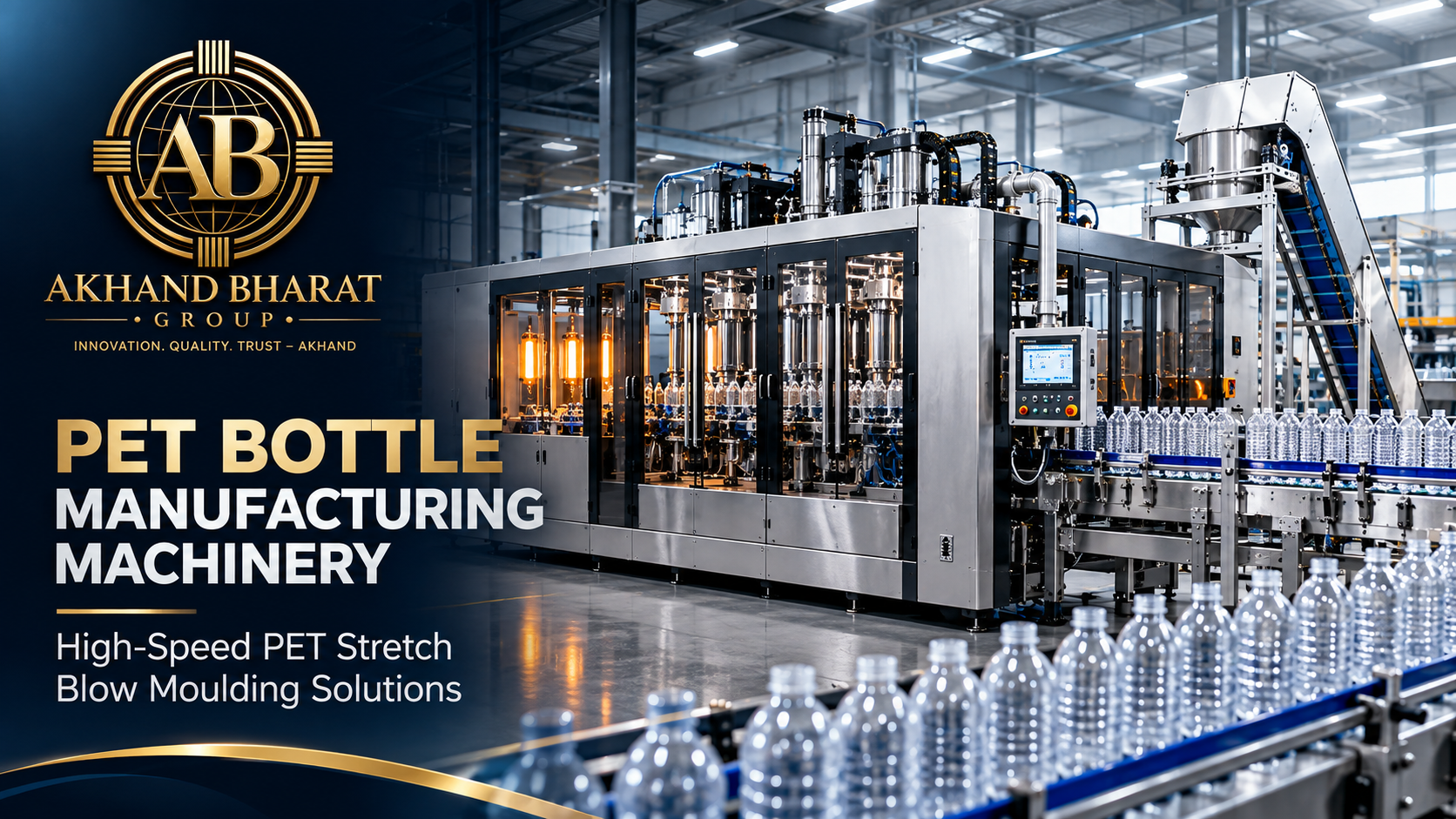
16-Cavity PET Blow Moulding Machine – High-Speed Bottle Production
SKU: ABG-PBM-EM16-25000
High-speed 16-cavity PET stretch blow moulding solution designed for efficient, stable and scalable production of PET bottles for beverage, edible oil, food, personal care and industrial packaging applications.
Overview
16-Cavity PET Blow Moulding Machine – High-Speed Production Solution The 16-Cavity PET Blow Moulding Machine is designed for high-efficiency production of PET bottles where production stability, energy efficiency, bottle quality and throughput are critical.
Key Features & Highlights
Key Features / Highlights
16-cavity high-speed configuration Automatic PET stretch blow moulding operation Servo-driven preform transfer system Precision preform heating control Modular heating system Servo-driven mould clamping High-pressure air recovery technology Stable continuous production Colour touch-screen HMI Compact machine arrangement Designed for integration with downstream conveying systems Suitable for multiple PET bottle formats
Applications
Applications
Packaged drinking water Carbonated soft drinks Juice and beverage bottles Edible oil bottles Tea and other beverage applications Food packaging Personal-care packaging Household and detergent bottles Selected industrial PET containers
Frequently Asked Questions
What makes this 16-Cavity PET Stretch Blow Moulding Machine different from conventional PET blow moulding machines?
This machine is engineered around system-level production efficiency, combining advanced preform heating, servo-controlled transfer, high-pressure air recovery, modular construction and automated process control. The objective is not simply higher cavity count, but stable high-speed production with controlled energy consumption, reduced mechanical losses and simplified maintenance.
Does the machine require a separate low-pressure air compressor?
The integrated air-recovery architecture is designed to recover usable high-pressure air after the blowing cycle and store it for reuse in low-pressure systems. The documented EM-series technology specifically states that the gas-recovery system can operate without a separate low-pressure air compressor.
How does the patented air-recovery system improve efficiency?
After the high-pressure blowing operation, usable compressed air is recovered into a storage system rather than being completely exhausted. The documented system achieves up to 45% air recovery, with the core air-recovery mechanism protected by a German patent. This can reduce compressed-air losses and contribute to lower operating energy consumption.
What is different about the PET preform heating technology?
The heating system uses a single-lamp bilateral heating architecture, independent lamp control and temperature feedback. This approach is designed to provide controlled and uniform preform heating while reducing heating power requirements. The documented system specifies approximately 2 kWh per 1,000 bottles for heating with a 12.5 g preform.
How is heating consistency controlled?
Each heating channel is independently controlled, while temperature feedback automatically adjusts the infrared heating system. The documented specification states that the temperature difference between heating channels is controlled within 3°C. This is important for maintaining consistent preform conditioning and reducing the risk of uneven bottle-wall formation.
Does the machine use a conventional chain-based preform transfer system?
The documented architecture uses a servo-driven screw-rod transfer system with specially designed carrier blocks and a U-shaped track. The carrier-block design is intended to reduce friction and required driving force while supporting stable high-speed movement. Advanced Block-Module Carrier Transfer Architecture rather than making an unsupported absolute claim about every competing machine.
What are the advantages of the carrier-block system?
The documented composite carrier blocks are designed for lower friction, reduced dust generation and long service life. The system also requires less driving force and occupies relatively little space, which can support compact factory layouts.
How does the modular heating-box design help maintenance?
The heating box uses a modular construction that provides easier access to lamps and water ducts during servicing. This can simplify maintenance intervention and reduce the complexity associated with servicing the heating section.
Is this machine designed for low maintenance cost?
The architecture is designed to reduce maintenance burden through modular heating components, composite carrier blocks, servo-driven movement and simplified service access. Actual maintenance cost will depend on operating hours, bottle configuration, utilities, preventive-maintenance practices and production conditions.
What is the theoretical production capacity of the 16-cavity configuration?
The documented 16-cavity configuration specifies a theoretical capacity of 21,000 bottles per hour (BPH) for bottles up to 750 ml. Actual production output depends on bottle design, preform weight, mould configuration, operating conditions and production settings.
What is the energy consumption of the machine?
For the documented configuration using a 12.5 g preform, the published figures are approximately: Heating: 2 kWh / 1,000 bottles High-pressure compressor: 6 kWh / 1,000 bottles Air recovery: up to 45% Actual plant energy consumption varies with bottle weight, preform design, production speed and operating conditions.
Why is air recovery important in PET bottle production?
High-pressure compressed air represents a significant operating-energy requirement in PET stretch blow moulding. Recovering usable air after blowing can reduce waste and improve the overall compressed-air efficiency of the production system. The documented architecture provides up to 45% air recovery.
Does the machine use servo technology?
Yes. The documented architecture uses servo-driven preform transfer and a servo-driven mould-locking mechanism with cam drive. Servo control supports precise positioning, fast movement and stable operation.
How does the machine support high OEE?
OEE is influenced by availability, performance and quality, rather than by one machine specification alone. This architecture addresses several OEE-related factors through: Stable servo-controlled movement Consistent preform heating Automated temperature feedback Air recovery Modular maintenance access Reduced mechanical friction Automated HMI-based operation Actual OEE must be established from production data for the specific bottle, mould, preform and operating environment. Actual OEE must be established from production data for the specific bottle, mould, preform and operating environment.
Does the machine incorporate patented technology?
The underlying technology platform includes documented patents relating to preform heating, preform infeed, moulding mechanisms and air recovery, with additional patents reported across multiple jurisdictions over its development history. For the ABG website, however, I recommend displaying specific patent numbers only after we receive and verify the patent documentation.
Why is the preform heating system important for bottle quality?
PET preform conditioning directly influences how material distributes during stretching and blowing. Controlled heating, independent lamp adjustment and temperature feedback help maintain a more consistent thermal condition before the preform enters the moulding stage.
Can the machine handle different PET bottle designs?
The technology platform is intended for automated PET stretch blow moulding across different bottle applications. The exact bottle range depends on preform geometry, bottle volume, mould configuration, neck specification and process parameters.
What makes this technology suitable for high-volume PET production?
The combination of 16-cavity production, servo-controlled transfer, automated heating control, air recovery and modular machine architecture is designed for high-throughput production while controlling energy use and maintenance requirements.
Is this machine focused only on production speed?
No. A high-speed machine is commercially useful only when speed is accompanied by stability, energy efficiency, repeatable bottle quality and manageable maintenance. The engineering approach therefore considers production rate together with heating efficiency, compressed-air utilization, transfer stability and serviceability.
How does the machine reduce the total cost of ownership?
TCO is influenced by more than purchase price. Key factors include: Energy consumption + compressed-air consumption + maintenance + component life + downtime + production stability + achievable output. The combination of air recovery, efficient heating, low-friction transfer and modular service architecture is intended to address these operating-cost drivers.
Why should a PET manufacturer evaluate this machine on TCO rather than only purchase price?
Because the economics of a PET blow moulding line continue throughout its operating life. Energy, compressed air, maintenance, downtime, production stability and usable output can materially influence the long-term economics of the machine. A proper technical evaluation should therefore compare: Energy / 1,000 bottles • Air consumption • Output • OEE • Maintenance requirements • Downtime • Bottle quality • Total Cost of Ownership rather than comparing machine purchase prices alone. 16-CAVITY PET STRETCH BLOW MOULDING MACHINE Advanced Heating • Patented Air Recovery • Block-Module Transfer • Servo Precision • High Production Efficiency Engineered for Lower Energy Consumption, Stable Production & Reduced Maintenance
Technical Specifications
| Machine Type | Automatic PET Stretch Blow Moulding Machine |
| Cavity Configuration | 16 Cavity |
| Production Capacity | Up to 25,000 BPH* |
| Bottle Capacity | Application/configuration dependent |
| Control | PLC + Colour Touchscreen HMI |
| Drive System | Servo-driven |
| Heating | Controlled PET Preform Heating |
| Mould Clamping | Servo + Cam Drive |
| Air System | High-pressure air recovery |
| Material | PET |
| Automation | Fully Automatic |
Enquire about this product
Request pricing, datasheets or a technical consultation for 16-Cavity PET Blow Moulding Machine – High-Speed Bottle Production.